A FURTHER WARNING: This is a really, really long post, folks, and it's still a simplified version of what is a very, very complicated process. If you aren't all that interested in the hows and whys of balanced and unbalanced translocations, I suggest you skip it. Sorry. Oh, and also my drawings are really bad.
So today's topic is the big one-- the one that caused it all. That, my friends, is Connor's genetic condition-- a submicroscopic subtelomeric unbalanced translocation 46xy der t(1)(1;15)(q42;q26.2). That's quite a mouthful! But what the heck does all of that gobbledygook mean?
To explain that, we're going to have to go back. Way back. Not to Connor's conception-- but to his dad Jeremy's. This is because while most genetic issues are what's called
de novo-- meaning they are spontaneous mutations that weren't passed down from either parent, that wasn't the case with us.
Every cell in the human body is a
diploid cell; it has within its nucleus 46 chromosomes-- 2 pairs each of chromosomes 1-22 and either a pair of X chromosomes or an X and a Y chromosome-- which carry all of the genetic information of that unique individual. Every cell, that is,
except mature sperm cells. During sperm cell production, the cell undergoes a process called
meiosis. It's a really complicated process, and you can see a video about it
here if you want the long complicated explanation, but when it's all over and done with you end up with four sperm cells with only 23 chromosomes in each sperm cell--
haploid cells. Here's a
basic explanation of the whole process if mine didn't make any sense.
Anyway, so on to fertilization. Sperm, meet egg. Egg, sperm.
The egg still has two full sets of chromosomes. However, just before it begins its journey to meet the sperm, the egg's chromosomes split apart. There's still 46 of them in there, but they aren't attached to one another any more. They stay this way until the sperm and the egg meet, and then the sperm's 23 chromosomes all pair up randomly with one of the egg's chromosomes. The sad loser wallflower egg chromosomes that didn't get picked up by the suave handsome sperm chromosomes are launched into oblivion in a little capsule called a polar body, leaving an egg with 46 unique chromosomes-- the beginnings of a new human being.
A crazy little fact-- there are 64 trillion different ways the egg and sperm chromosomes can combine, pretty much ensuring that all of your children will be absolutely unique, unless you are having identical twins, which I'm not going into here. Um, anyway, back on topic.
So in all of this chromosome tangoing, there is room for error. Sometimes when the chromosomes are doing their delicate dance of separation and partnering, something goes wrong.
So here's our starting point:

In Jeremy's case, what happened is when either the sperm or the egg did their initial division, perhaps during the process called
crossing over, or during the time that the sperm and egg were combining, two tiny pieces of chromosomes 1 and 15 broke off.
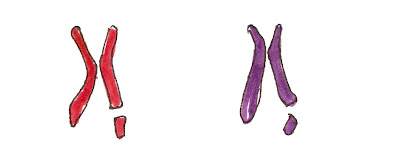
They then switched places. This is called a
balanced reciprocal translocation. All of the genetic information was still there-- it was just in the wrong place.

What effect did this have on Jeremy? Absolutely no effect, that's what. We had no idea, in fact, that he had anything different about his DNA at all until we had Connor.
So here's the deal. Jeremy's sperm go through meiosis. Remember he has two copies of chromosomes 1 and 15-- one with the error, and one without. So what happens is that as the sperm cells divide, they can end up with one of four different combinations of those two chromosomes:
Sperm 1: Has two normal chromosomes.
Sperm 2: Has two abnormal chromosomes.
Sperm 3: Has a normal chromosome 1 and an abnormal chromosome 15
Sperm 4: Has an abnormal chromosome 1 and a normal chromosome 15

So what happens in each of these scenarios when these sperm meet with an egg containing normal chromosomes?
Sperm 1 + Egg = A completely normal pair of chromosomes on both 1 and 15. This baby would have no genetic issues and could not pass on any issues to his or her children.
Sperm 2 + Egg = Another balanced reciprocal translocation. This baby would have all of the genetic information there and be unaffected just like his or her father, but would also run into the same issues when it's time for baby making as dear old dad had to deal with.
Sperm 3 + Egg = Uh oh. Here's where we start running into trouble. Because only one of the abnormal chromosomes was passed on, this baby has an extra bit of chromosome 1, and is missing a piece of chromosome 15. This is called an unbalanced translocation. Not all of the information that's needed is there, and some of the information is copied too many times. This leads to all kinds of problems, depending on what information is missing and copied.
Sperm 4 + Egg = Uh oh again. This baby is missing information on chromosome 1 and has too much of chromosome 15. This is what Connor has, and is the cause of all of his birth defects-- key "instructions" for his development were missing or altered from what they should have looked like.

So with that complicated explanation out of the way, lets break down that whole long mess I listed up there at the top. We can take it piece by piece.
submicroscopic: Connor's genetic issues are so small you can't see them under a microscope or with regular genetic tests. We had to use a special test to find the issues.
subtelomeric: This talks about the general location of the issues. The ends of the chromosomes are called the
telomeres, so 'subtelomeric' means that Connor's deletion and duplication are right at the very ends of the chromosomes, instead of being somewhere in the middle.
unbalanced: Not all of the information that's supposed to be there is there, or too much is there.
translocation: Pieces of the chromosomes have switched places.
Okay, here's where we get into the really technical mumbo-jumbo
46: This is the number of chromosomes Connor has.
XY: This means Connor is a boy, with one X chromosome and one Y chromosome.
der: This stands for
derivative chromosome. Basically it means a chromosome that is abnormally formed of two pieces of different chromosomes.
(1): This means that chromosome 1 is the derivative chromosome, or as I like to call it, the "Frankenstein" chromosome.
(1; 15): These are the two chromosomes that are affected by the unbalanced translocation. The one with the deletion is listed first, and the one with the duplication is second.
(q42; q26.2): This is giving a specific "address" for the unbalanced translocation. A little explanation:
Each chromosome has two "arms"-- the long arm is the 'q' arm and the short arm is the 'p' arm. The chromosomes are further divided into
cytogenic bands-- lines on the chromosomes that appear using certain stains and are numbered. The further away from the center of the chromosome, or
centromere, they are, the higher the number. Each band is also divided into sub bands, and sub sub bands. Complicated, no? The chromosomes are numbered from longest to shortest, so while the 'q' arm, or long arm of chromosome 1 has four bands, the q arm of chromosome 15 only has 2. What (q42; q26.2) means, then, is that Connor has a deletion of the long arm, or q arm, of chromosome 1 from band 4 sub band 2 to the end, or telomere, and a duplication of the q arm of chromosome 15 from band 2 sub band 6 sub sub band 2 to the telomere.
Hence, submicroscopic subtelomeric unbalanced translocation der t(1)(1;15)(q42;q26.2) Whew!
So in addition to all of the different birth defects caused by Connor's genetic condition, he also has what are called
dysmorphic features. Now, while having one or two of these doesn't mean that your child has a genetic condition, if you take them all together it may mean it's more
likely they have one. Every different chromosomal disorder will have its own set of dysmorphic features, and these can be used as clues to help figure out what to test for. The geneticists are kind of like detectives-- trying to use these clues to figure out which genetic syndrome is likely. While there aren't any people we know of with Connor's
exact chromosomal condition, there are enough people with similar submicroscopic 1q deletions that we now have a general idea of what those features are. I'm hoping they're slowly working towards classifying these 1q deletions as a syndrome-- hopefully a syndrome with a really
short name, as then I could just say "Blah blah syndrome with a 15q duplication" instead of reciting everything. I'm tired of watching people's eyes glaze over after they make the mistake of asking me what Connor's genetic condition is called. Here are the some of the dysmorphic features Connor has that are associated with submicroscopic 1q deletions:
Epicanthal folds-- this is where a skin fold from the upper eyelid covers the inner corner of the eye.
Down Syndrome is another chromosomal disorder that shares this dysmorphic feature.
Tapering fingers-- Connor's fingers are wide at the base and taper to very narrow ends.
Inset toes-- The second toe on each foot is set up higher on his foot than his other toes
Full face-- Connor probably won't ever lose those chubby little cheeks-- they're part of his genetic condition.
Thin upper lip-- Connor's upper lip is turned under and very, very thin.
Smooth philtrum-- The philtrum is the line between the nose and the mouth. Connor doesn't have one.
Smooth nasal bridge-- Connor's nasal bridge is completely flat, which gives him that cute little turned up nose.
Here are some links for you if you are looking for more information. Not all of these are free, however-- you have to belong to the medical journals to see the full text on a couple of them. I suggest making your way to your local hospital's library if you want to see more than the abstracts-- they usually have subscriptions.
About submicroscopic subtelomeric 1q deletions:
There's pretty much nothing out there in regards to submicroscopic subtelomeric 15q duplications. Let me know if you find something, and I'll link it here.
Here are some support groups for rare chromosomal disorders:
Um, yeah. Explanation over. Finally.


 Posts
Posts